
Build, analyse, advise.
We build the systems Indonesia uses to plan, fund and track climate action, and advise on the methods behind them.
Application Development
Platforms that ministries and regions use to plan, monitor and report, built around the regulation they serve.
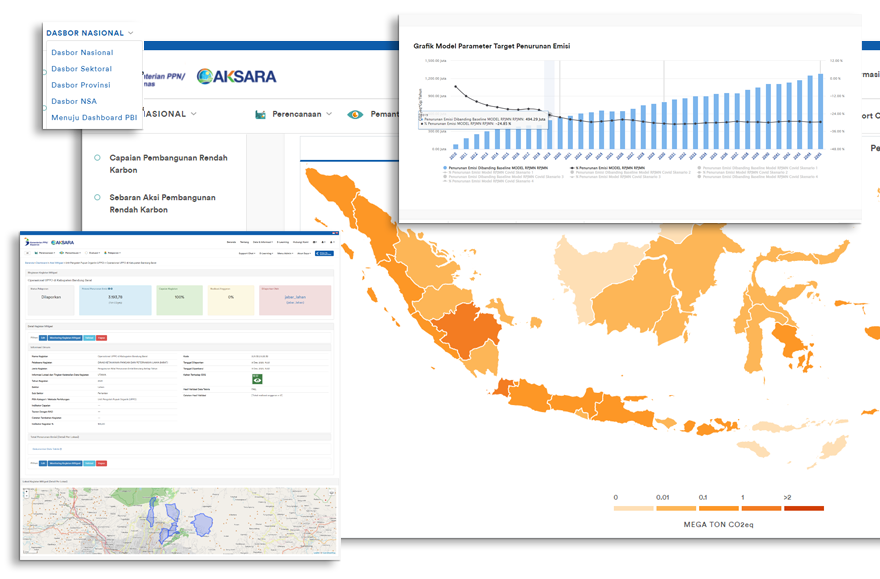
Who it is for
- National ministries. Planning, monitoring and reporting systems built around your regulation.
- Regional governments. Calculators that follow the regulation, and e-learning with certificates for regional teams.
- Development partners. Programme goals turned into software the government owns, uses and keeps.
What you get
- Platforms with planning, monitoring and reporting modules
- One participatory system where ministries and regions do all three, as they do in AKSARA.
- APIs for data exchange
- Django and Python back ends with full API support, built for data exchange across platforms.
- Calculators that follow the regulation
- Decision tools that apply a regulation’s calculation rules for local governments.
- Learning platforms with exams and certificates
- Moodle courses with interactive video, quizzes, a final exam and printable certificates.
Built with
Django
Python
Laravel
PHP
Moodle
- REST APIs
Selected cases
-
AKSARA
Bappenas and GIZ
76,777 actions recorded in AKSARA from across Indonesia, as of October 2026.
Source: AKSARA records
-
Waste Management Calculator
Integrated into AKSARA
Follows Ministry of Home Affairs Regulation No. 7/2021 to calculate waste retribution tariffs, operating costs and investment plans.
Built for local governments
-
AKSARA E-learning
Bappenas, GIZ and Universitas Multimedia Nusantara
Users who pass the final exam can download a certificate with a score for each topic.
Moodle, for AKSARA users in the regions
Data Dashboards and Analysis
Dashboards, maps and scenario tools that turn national datasets into answers people can read without specialist training.
Who it is for
- National ministries. Budget tagging and public dashboards that hold up to national reporting.
- Development partners. A public map of your programme’s projects across Indonesia.
- Associations and the public. Maps, calculators and libraries that make a sector easier to understand.
What you get
- Dashboards and public data portals
- Open views of public data, like climate budget tagging for ministries (CBT) and regional governments (RCBT).
- Spatial analysis and maps
- Data read by place and mapped, from development projects across Indonesia to biogas potential and installations.
- Scenario tools with system dynamics
- Powersim models behind a JSON API, so many stakeholders can test emission-reduction scenarios in the browser.
- Machine-learning tagging
- Models that sort climate budgets into mitigation, adaptation and co-benefit, as built for CONNECT.
Tools and methods
- Highcharts
- Highcharts Maps
- Powersim SDK
- JSON API
- Machine learning
Selected cases
-
CONNECT
Ministry of Finance (Kemenkeu)
600+ trillion rupiah
of climate-related state budget (APBN) realisation for 2018 to 2026, as published on CONNECT.
Source: connect.kemenkeu.go.id.
Our part: the cross-platform integration and the machine-learning engine that tags the budget.
-
System Dynamics on AKSARA
Bappenas
National and sub-national Powersim models run on the server, and a JSON API brings them to the browser.
Our part: the interface, the API and the data visualisation.
-
ABgI Knowledge Hub
Asosiasi Biogas Indonesia (ABgI)
20 titles
in the publications library, alongside a biogas map and an industrial-scale biogas calculator.
Source: abgi.or.id.
Strategic Environmental Consulting
The methods behind the systems: M&E frameworks, methodology, policy integration and training for the people who use them.
Who it is for
- National ministries. Methodology and M&E frameworks for national priorities, from low carbon development to climate resilience.
- Regional governments. Guided reporting and training for the teams that report from the regions.
- Development partners. An implementation partner for the method as well as the software.

What you get
-
Monitoring and evaluation frameworks
M&E frameworks for central and local governments, from the Low Carbon Development Initiative to the National Circular Economy Action Plan.
-
Methodology development
Methods and guidance for measuring progress, like the monitoring methodology and publication guidance behind AKSARA for Climate Resilience.
-
Policy integration
We start with the regulation, then write the code. The waste calculator follows Permendagri 7/2021, and AKSARA tracks the RPJMN and international commitments.
-
Capacity building and events
Capacity development and events for the people behind the data, and e-learning for users in the regions.
Practice areas
- Climate adaptation and resilience
- Low carbon development
- Waste and circular economy
- Climate finance
- Research and policy documents
Selected cases
-
Built to fulfil RPJMN national priority PN 6.2.2.
-
Updates the National Circular Economy Action Plan, then monitors it indicator by indicator.
Ways to work with us.
-
Build a new platform.
From the regulation to planning, monitoring and reporting modules, with the APIs and the training around them.
You have a regulation, but no system yet.
AKSARA, with Bappenas and GIZ
Read the case: AKSARA -
Add a module.
New modules on a system you already run, the way AKSARA grew into climate resilience, scenarios, waste and e-learning.
Your platform is running and needs a new function.
AKSARA for Climate Resilience, with Bappenas and ADB
Read the case: AKSARA for Climate Resilience -
Turn your data into a dashboard or a map.
Public dashboards, maps and scenario views, from climate budget tagging to projects across Indonesia.
Your data is hard to read at a glance.
CBT and RCBT dashboard, Ministry of Finance
Read the case: CBT and RCBT dashboard -
Design the M&E framework or methodology.
Indicators, methodology and monitoring guidance for central and local governments.
Your plan has to show its progress.
RANES, with Bappenas and UNDP
Read the case: RANES -
Train the people who use it.
Capacity development, events and e-learning with quizzes, a final exam and certificates.
Your users need to learn the system.
AKSARA E-learning, with Bappenas, GIZ and UMN
Read the case: AKSARA E-learning
Or write to info@etuya.id.
One team, from regulation to training.
Environmental experts and software engineers work side by side, so the method and the code are designed together.
Four disciplines
- Information Technology
- Meteorology and Geography
- Renewable Energy
- Civil Engineering
How we deliver
- Read the regulation and the data
- Design the structure
- Build, integrate, maintain
- Train the people who use it
Questions before we start.
Another question? Start a conversation
Who have you worked with?
Bappenas, the Ministry of Finance, the Ministry of Home Affairs and the Ministry of Public Works, with ADB, GIZ, UNDP, WRI and KOICA, plus KLHK and Universitas Multimedia Nusantara on specific projects.
Do you work with regional governments?
Yes. AKSARA is used by national and sub-national governments, the waste calculator was built for local governments, and AKSARA e-learning trains users in the regions.
Can you work inside a development-partner programme?
Yes. Our platforms have been delivered with GIZ, ADB, UNDP and KOICA alongside the ministries that own them.
Do you only build software?
No. We design monitoring and evaluation frameworks, develop methodology, integrate policy and train the people who use the system.
What happens after launch?
Maintenance and capacity building are part of how we deliver. AKSARA is the example: it kept growing with new modules.
Which technologies do you use?
We have built with Django and Python, Laravel and PHP, Moodle, Powersim SDK, Highcharts, JSON APIs and machine learning.
Can I see your work?
Yes. CONNECT (opens in a new tab), the ABgI knowledge hub (opens in a new tab) and AKSARA (opens in a new tab) are online, as are LCDI Indonesia, the Energy Hub and easyLCA. Each case study links to its platform.
How do we start?
Send us the policy or regulation, who will use the system, and the data you already have. That is enough for a first conversation.